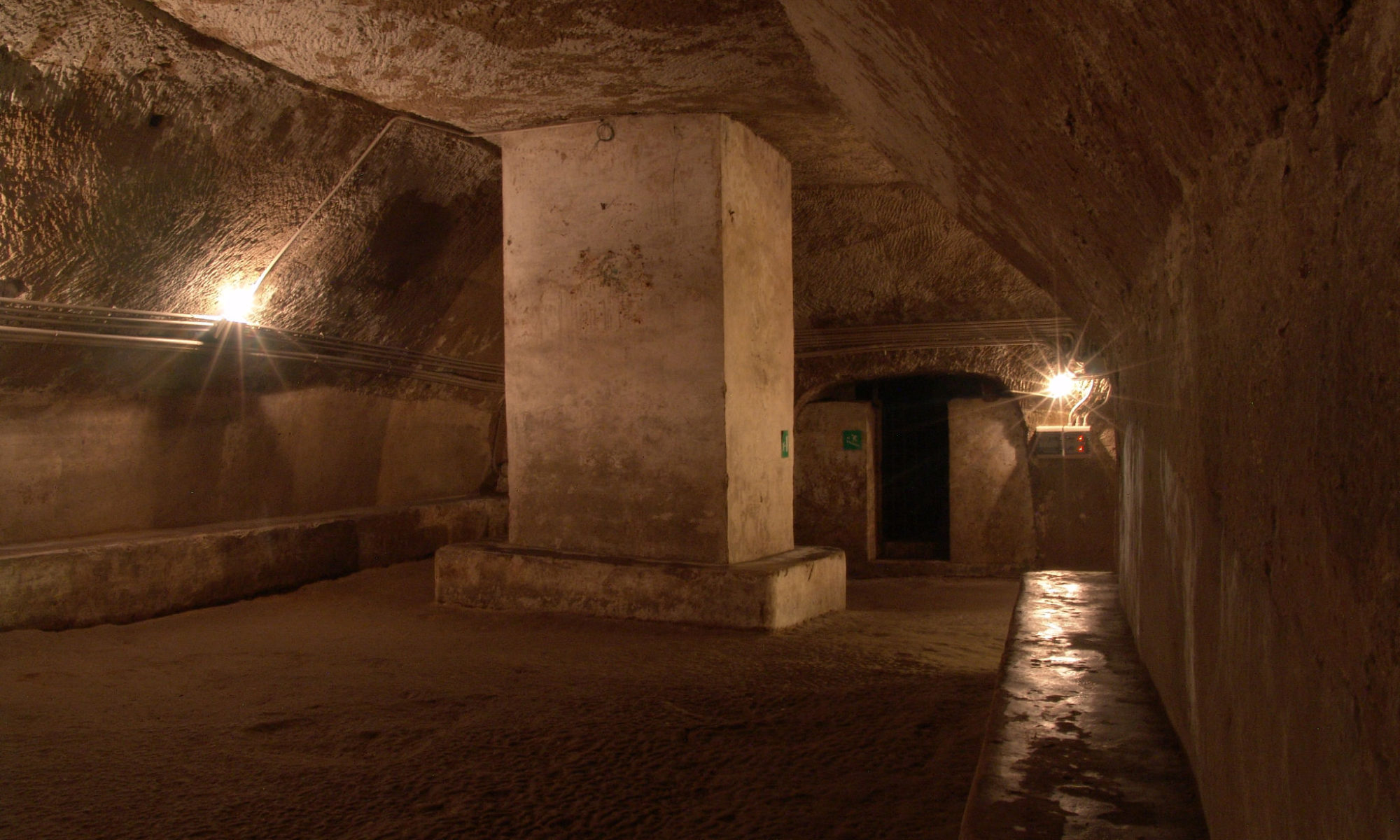
1st Cistern

Welcome to the Naples underground! We are now at a depth of approximately 30 meters below street level and the temperature ranges somewhere between 16 and 18 degrees Celsius with a humidity level of approximately 70-80%. These caverns were created by Greek colonists who in the 4th century BC began to extract the stone material required to build the city that is located above us: Neapolis, or “new city.”


These caverns that were initially created as quarries were later used as aqueducts by the Greeks, who connected the cisterns through a network of tunnels that brought the water from a spring on the slopes of Mount Terminio (the Serino aqueduct).


For approximately two thousand years, the aqueduct was used continuously, until the end of the 9th century when it was closed due to a cholera epidemic, only to be reopened again in 1942 to be used as an air-raid shelter.

2nd Cistern

We are now below the San Paolo Maggiore basilica. This well was left open to allow for circulation of air and also because it was believed that it was unlikely that a building belonging to the Church would ever be bombarded.


The red plaster on the walls was created by the Greeks using a mixture of lime, tuff powder and vegetable oil, and it was actually used to waterproof the tuff stone up to the highest water level.

3rd Cistern

Notice here another closed off well and this mannequin that simulates the descent of the pozzari, or aqueduct workers; the system of steps was located foremost in the perimeter wells to allow easy passage along these so-called walking walls used by the pozzari to navigate at water level and to monitor its cleanliness.

4th Cistern

We created this simulation to help you understand how the ancient Greeks used to work. The Greek and Roman slaves placed wooden wedges into the cracks, similar to those called “cugnoli”: they soaked them in water, the wood then expanded, which caused the cracks to split and they removed the blocks. Afterwards, still deep in the underground using only three tools—a hammer, a chisel and a small hatchet called a smarra—they were fashioned into parallelepiped blocks. The larger ones were used for the walls of the city, and the smaller ones for the city’s buildings.

5th Cistern

The panel of photographs that you see in front of you depicts the most significant moments during the anti-Nazi rebellion that took place during the Occupation of Naples.


The tank that you see recreated inside this cistern is an art installation that recalls the moment when the Neapolitans drove the Nazi soldiers out of the city. The old masks are actually real and they were given out to the civilians who were inside the bunker in order to filter the air in case of bombardment.


6th Cistern

These plants that you see here are the result of a botanical experiment by the Federico II University. They can grow without being watered, since they get sufficient moisture due to the high level of humidity in this environment. Sunlight is replaced by cold light lamps.

7th Cistern

We are about to pass through a candlelit tunnel with a length of approximately 150 meters, a height of 10 meters and a width of half a meter.


We will see some cisterns that are artificially flooded with water in order to convey the idea of how the aqueduct worked during ancient times. At the end of the tunnel we will see the Hypogeum Gardens, where herbs and fruit-bearing plants are grown.

8th Cistern

This order is devoted to the patron saint of Naples who, like San Gennaro, performs the miracle of liquefaction of her own blood not two times per year, but once a week.

We are now beneath Via San Gregorio Armeno, specifically below the cloisters of the same name.

This last cistern, as you can see, was transformed into a cellar when the aqueduct was closed. It served as the private larder for the Sisters of Santa Patrizia up until 1952.

The nuns accessed this cellar directly through this staircase, thereby avoiding all contact with the public in keeping with their vows. It here that they also aged the wine called “TUFELLO.”


The Roman Theater

Inside the basso

As you can see we are inside a private residence. This is a basso, a typical Neapolitan ground-level home, which was inhabited up until about ten years ago.

As with many other basso homes, the family who lived here had a cellar where archaeologists discovered a section of the Neapolis Roman Theater when moving aside this bed.